Excerpts: " On Thursday, October 18, 2007, the Committee held a hearing to examine the climate change and other impacts of black carbon emissions. Black carbon is better known as soot and results from the incomplete combustion of fossil fuels and biomass. Five leading researchers in the fields of climate and atmospheric science, environmental engineering, earth system science, and environmental epidemiology testified at the hearing. The Committee received testimony about the significant global and regional effects of black carbon, its sources, and the positive effect reductions in emissions would have on both climate change and public health worldwide. "
1. Black Carbon Is the Second Leading Cause of Global Warming.
2. Black Carbon Is of Particular Importance in the Arctic.
3. Sources of Black Carbon Are Diverse in Nature and Geographic Location.
4. Decreasing Emissions Will Immediately Slow Global Warming.
5. Decreasing Emissions Will Immediately Improve Public Health.
5. Opportunities to Decrease Emissions Exist Now.
Hearing Summary (28 KB)
Testimony of Dr. Mark Jacobson (1 MB)
Testimony of Dr. Tami Bond (167 KB)
Testimony of Dr. V. Ramanathan (1 MB)
Testimony Dr. Charles Zender (2 MB)
Testimony of Dr. Joel Schwartz (176 KB)
Preliminary Hearing Transcript (238 KB)
Friday, November 14, 2008

Thursday, October 23, 2008
[Asia] Fires and Smoke near Yakutsk, Russia , 2001/07/19, 20
In the Sakha region of Siberia, at the eastern edge of the Central Siberian Plateau, numerous fires were burning near the city of Yakutsk, along the bank of the Lena River.


2001/201 - 07/20 at 03 :20 UTC

2001/201 - 07/20 at 03 :20 UTC
During the summer in the boreal forests of Russia, fires are generally ignited by lightning striking the surface (more details can be found in Evolving in the Presence of Fire).

2001/200 - 07/19 at 02 :40 UTC
It is worth noting how the smoke plumes are thicker in the afternnon scene.

2001/200 - 07/19 at 02:40 (up) & 04 :15 (down) UTC

2001/201 - 07/20 at 03 :20 UTC

2001/201 - 07/20 at 03 :20 UTC
Wednesday, October 22, 2008
[Asia] Haze from China, 2001/07/12

2001/193 - 07/12 at 02 :40 UTC
Haze is a generic term for visible air pollution, and can consist of dust, smoke, and other particulate matter. As China has grown as an economic power, air pollutants from industry and automobiles (mostly coal-fired or sulfur contained fuel) have increased dramatically. This has lead directly to increases in sulfur dioxide, nitrogen dioxide, soot, and other atmospheric pollutants. Haze plume over eastern China~the Gulf of Bohai (the center of the image with the port city of Tianjin nearits western shore) is clearly seen in this image. East-West haze plume obscures the coastline of Eastern China. Beijing (China´s capital and second largest city) is located in the upper left portion of the image.
[Asia] Fires in Sumatra, Indonesia, 2001/07/09

Terra/MODIS 2001/190 - 07/09 at 03 :59 UTC
Forest fires in July are famous guest on the Indonesian island of Sumatra.
This MODIS image shows that the number of fires and emitting smokes.

SPOT 1 Image 9 July 2001
Excerpts: "The fires producing most of the smoke haze are in coastal peat swamp east of the River Barumun. The forest in this area, some 120 000 ha, has been unsustainably logged for many years and is now in the process of being cleared, using fire, for conversion to estate crops. These relatively minor haze events last from one to three weeks during a dry spell and come to an end with the onset of rain."
[S.America] Fires and Smoke over Brazil, 2001/06/12

2001/163 - 06/12 at 14 :15 UTC
Several fires in Mato Grosso State, Brazil are found. Fires emit smoke plume.
Green area is, in general, healthy vegetated area but light green land covers are deforested area.
[Asia] Fires and Haze in China, 2001/06/06
Lots of fires in China (red dots) are shown in this earlist Terra/MODIS imagery of aerosols over China.
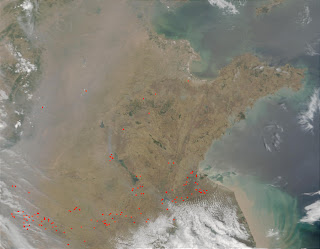
2001/157 - 06/06 at 03 :05 UTC

2001/157 - 06/06 at 03 :05 UTC
[Asia] Dust storm in Southern Afghanistan, 2001/06/02, 11, 13
Afganistan is one of severe dust strom origins.

2001/153 - 06/02 at 06 :50 UTC

2001/162 - 06/11 at 06 :45 UTC

A Dust StormEngulfs Kandahar on May 13 , 2001

2001/153 - 06/02 at 06 :50 UTC

2001/162 - 06/11 at 06 :45 UTC

A Dust StormEngulfs Kandahar on May 13 , 2001

Subscribe to:
Posts (Atom)